
According to human (and maybe some other) theory, nature should be approximately in balance. This says to me that no one species should be so dominant that it overtakes the earth — to the exclusion of other species. In other words, every species should have other predators to keep that species in check. (Clearly the human species violates this, but one line of thinking or belief has given us that as a birthright.)
So here I’ll consider only what we might call “lower species.”
Well, I think there is at least one other animal species that tries for this dominance. It lives in the outdoors, in cracks, corners, and within walls of our homes, workplaces, or just about anywhere we might go. They live in places we would not want to go, too.
What is this species?
Spiders
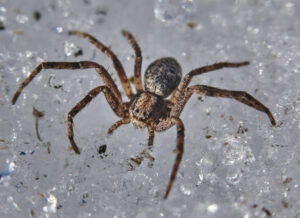 Spiders are a part of our environment. You would think these eight-legged creatures would serve a purpose in nature’s “balance” to keep other species (primarily insects?) in check so they don’t overwhelm the system.
But the problem seems to be that, in turn, spiders do not have enough predators either willing, able, or ready to keep spider numbers in check.
Spiders are a member of the biological Class Arachnida and Order Araneae. (With those two most valuable pieces of information, don’t you feel empowered by your increased knowledge?)
Now I’m not writing about the types of huge spiders often seen in horror movies. Nor even those I see typically warned about in health brochures or the media such as the black widow or the brown recluse.
I’m thinking generally about smaller spider species. I don’t know their species names, but most aren’t much more than an inch across. Those we deal with mostly are only about half an inch long.
They find ways into our house, garage, and shed.
Most seem to come in through small gaps around doors and windows, but some appear to come in through wall electrical outlets and plumbing pass-throughs. (What do you have hiding in your walls?)
My primary problems with them, besides just having their bodies present are:
1 – their webs.
Their webs are generally white in color. In a mostly white environment, we often can’t see a web unless the sunlight or some other light shines directly onto it.
They have totally taken over our shed. Both windows, the walk-through paned glass door, and much of the internal walls are covered with spider webs. The webs themselves are bad enough, making the shed appear unclean, unhealthy, and unfit for human existence. But worse, the sticky webs collect dust. The dust on the webs, over time, turns brown, gray, or black, making the space appear even uglier and more unfit.
They like our garage, too, but not as much. We do a thorough cleaning there twice a year to maintain some semblance of control.
We spend more time living in the house, so it’s easier to maintain better control there. Every time I see a spider, I do a walkthrough search of their most common places. They do move around occasionally and rebuild their webs in different locations to pollute our environment further.
Some of the places they choose don’t make a lot of sense to me. They hide in corners or behind objects. For a passive victim collection system, you’d think they’d want to be more efficient — out in the open.
With the warmer weather in the spring, summer and fall, I typically find about half a dozen every few days.
Other spiders seem welcomed by the web’s presence and join them nearby to compound the problem.
And when the spiders die, if I don’t kill them first, they don’t take their webs with them. Those are left to pollute.
2 – their droppings.
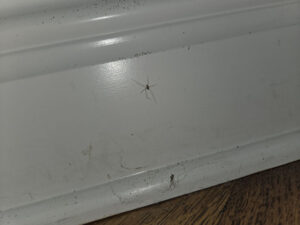 Their droppings appear to be of two colors — white and black — maybe based on the species. I don’t know.
On a white surface, you can see the black. On a black surface, you can see the white. I wonder how much of the black and white we can’t see on the same color surfaces. This “material” is difficult to clean. We have unintentionally rubbed off and removed paint trying to get rid of the spots.
If these spiders served some useful purpose, they might be considered less of a problem. But we haven’t found anything they do for us yet. With their established webs generally serving only as a passive search for food, not an active, the number of bugs they capture and consume doesn’t appear to significantly reduce the number of bugs in the house or elsewhere.
Now I would call each of them an illegal immigrant. The problem is that I have no official legal authority to do so. The most I can do is make rules to ban them from the house. Could I then call them an unruly immigrant? Maybe I could use undocumented, because no formal documents or records are ever kept? They and their webs, along with the desiccated body parts of their rare victims, simply get smashed and wiped up with a tissue of some kind and disposed of in the trash.
When the weather turns cooler in the fall, we get larger brown spiders (similar to the first image above) about 1 inch long coming in from the cold. They are more active than the smaller ones. It takes a flyswatter to chase down and kill them.
It’s essentially impossible to deny them access without an air-tight structure — which is impossible in itself without tremendous expense. Even with that, I figure with their apparent nearly infinite numbers. they’d still find a way in.